
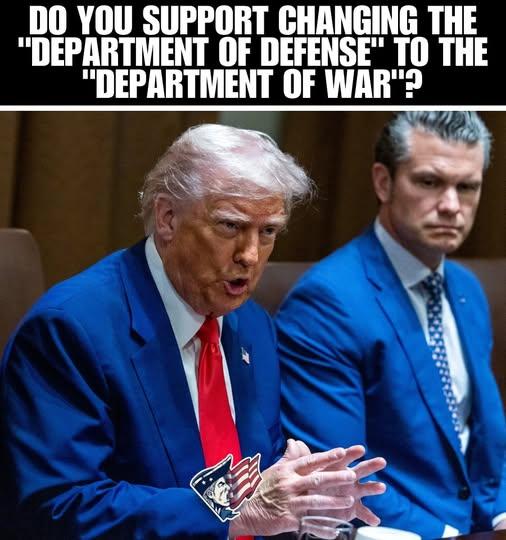
The question of whether the United States should rename the Department of Defense to the Department of War has recently stirred up controversy, especially as former President Donald Trump and his supporters continue to challenge long-held political norms. At first glance, the suggestion may appear to be a mere matter of semantics, a change in wording without real impact. Yet language is power, and names carry profound symbolic weight. The phrase “Department of Defense” suggests a nation that only acts to protect itself, while “Department of War” signals something more aggressive, perhaps even unapologetic. This debate raises the issue of whether America should present itself honestly as a nation that has long projected military might far beyond its borders, or whether the softer term “defense” more accurately reflects the values the country hopes to embody.
Historically, the United States did in fact operate under a Department of War. From the nation’s founding until 1949, this was the official name for the federal agency responsible for military affairs. After World War II, in the aftermath of catastrophic global conflict, policymakers decided that the term “war” sounded too confrontational, too harsh in a time when the country wanted to present itself as a global stabilizer and peacekeeper. Thus, the Department of Defense was created, not only as an administrative restructuring but also as a branding exercise, projecting the idea that America fought only when necessary. But decades later, with interventions in Korea, Vietnam, Iraq, Afghanistan, and countless other theaters of conflict, critics argue that the term “defense” is misleading. America has often taken military action preemptively, in ways that look much more like acts of war than acts of protection.
Trump’s blunt political style often cuts through euphemisms, and it is no surprise that such a suggestion would resonate with his base. To many of his supporters, the idea of renaming the department to reflect its true purpose is a matter of honesty. Why pretend the United States is always defensive, they ask, when the reality is that the country maintains the world’s largest military budget, overseas bases across more than 70 nations, and a defense industry that profits massively from perpetual conflict? To them, calling it the Department of War would strip away the mask and show the raw truth: America wages war to secure interests, and this is nothing to be ashamed of.
On the other side of the debate, critics warn that such a renaming would send a dangerous message both to the world and to Americans at home. Words shape perception, and perception influences policy. Calling it the Department of War could make it easier for leaders to justify aggressive military actions, because the very name presumes conflict is the department’s primary function. Defense, by contrast, implies caution and restraint. It reminds Americans that military power is ideally a last resort, used only when the homeland or core values are under genuine threat. To abandon that framing would, in the eyes of many, normalize permanent militarism.
There is also a psychological dimension to consider. For decades, American citizens have grown up with the idea that their armed forces are a protective shield, ensuring peace and safety in a dangerous world. To suddenly rebrand that shield as a sword would unsettle many, forcing citizens to confront the contradictions of American foreign policy. This might spark deeper questions about whether endless interventions truly serve democracy or whether they simply entangle the country in costly and unwinnable conflicts. Some argue that this confrontation with reality is exactly what the nation needs, while others fear it could erode public trust and morale.
Internationally, such a renaming would undoubtedly reverberate. Allies might interpret it as a signal that the United States is preparing to embrace a more overtly militaristic identity, while adversaries could seize upon it as propaganda, pointing to American aggression as proof of imperial ambition. The global image of the United States, already complex and contested, could tilt even further toward the perception of a nation that solves disputes with force rather than diplomacy.
Yet beyond politics, this debate forces Americans to consider what they truly expect from their government and their military. Is honesty about power more valuable than maintaining a reassuring image of defense? Is it better to embrace the raw truth of America’s role in global conflicts, or to uphold the hopeful fiction that the nation’s might is always used in service of freedom and protection?
Ultimately, the renaming debate may never result in an actual change of title. The Department of Defense is deeply entrenched, not only in law but in culture. However, the very fact that this conversation has entered the political arena is revealing. It exposes an undercurrent of frustration with political double-speak, and a growing desire among many Americans to see their government speak plainly about its actions. Whether one supports or opposes the idea, it forces citizens to wrestle with fundamental questions about war, peace, and the narrative that binds them together.
The discussion about renaming the Department of Defense is not just about a name. It is about identity, honesty, and the story America tells the world—and itself—about what it fights for. The choice between “defense” and “war” may seem like a matter of words, but in reality, it reflects the heart of how a superpower defines its mission in history.